What is brain rot? Meaning, origin and what to do
Brain rot describes digital content seen as low in quality or value, and the supposed mental decline from consuming too much of it. Oxford University Press named it its 2024 Word of the Year. The term is much older than short-video apps: its first recorded use is from Thoreau's Walden in 1854.
Coming soon to iPhone
What does brain rot mean?
Oxford University Press defines it, in the wording Wikipedia quotes, as the supposed deterioration of a person's mental or intellectual state, especially as the result of overconsumption of material, now particularly online content, considered to be trivial or unchallenging. People use it in two ways. One names the content: short, repetitive, meme-heavy videos or what some call AI slop. The other names the effect: the foggy, scattered feeling after a long scroll.
Both uses are informal. Brain rot is a cultural label and not a medical term, and the effects it points at are not a diagnosis.
You will see it in three common forms. As a noun for content, as in that video is pure brain rot. As a description of a state, as in I have brain rot after that session. And as an in-joke among people who spend a lot of time online and say it with a grin. The meaning shifts with the speaker, so it helps to ask which use is in play before arguing about it.
Where does the term come from?
According to Oxford University Press, the first recorded use is in Henry David Thoreau's 1854 book Walden. Thoreau wrote that while England tries to cure potato rot, nobody tries to cure the brain rot that spreads much more widely and fatally. He meant a taste for trivial ideas. The 1840s potato blight in Europe gave him the comparison.
So the worry about trivial content is 170 years old. What changed is how often a phone puts it in front of you.
Thoreau was not writing about screens, and he would not recognize a short video feed. The reason to mention him is perspective: complaints about trivial reading and thinking have followed every new medium, from cheap novels to television. Each generation finds its own version of the same fear, and that is a reason for curiosity and not for panic.
The modern comeback came in stages. According to Wikipedia, use of the phrase increased online in the 2010s, spiked in 2020 in online chat communities, where it became an internet meme, and then moved into everyday speech. A phrase from the 1850s ended up as a joke about short videos 170 years later.
Why was it Word of the Year in 2024?
Brain rot was Oxford's 2024 Word of the Year, ahead of other finalists such as demure and romantasy. Oxford reported that the term's use rose by 230 percent in frequency per million words between 2023 and 2024. Gen Z and Gen Alpha popularized it online, often with irony, which Wikipedia notes. By 2024 mental health organizations had also begun to use the term to talk about prevention.
How is it linked to doomscrolling and infinite feeds?
Brain rot overlaps with doomscrolling, which is spending too long on content that stirs up negative emotions. Both depend on feeds that never end. Infinite scrolling was filed as a patent application by a software team on 14 February 2006 and removes natural stopping points. Without a stopping point, time passes because nothing tells you to stop.
The two terms differ in emphasis. Doomscrolling is about the mood the content produces. Brain rot is about the content's quality and what it does to attention.
Is brain rot real?
The word is real as a description of experience. People do report that long sessions of short videos leave them scattered. Whether specific content causes lasting cognitive harm is a harder claim, and this site does not make it. The useful, testable part is smaller: how much time you spend, how often you open an app without choosing to, and whether you like what the time bought you.
Ebb is built on that smaller idea and calls itself a speed bump, not a cure.
A fair reading is this. The worry is old, the word is popular, and the specific science is still being sorted out. Be cautious with anyone, including an app site, who gives a precise figure for how much a feed changes your brain. A sober approach is to watch your own signs, such as trouble reading a long page, restless checking and lost evenings, and to change the habit if you do not like them.
What can you do about it?
Start with your openings, not your hours. Count how many times a day you open a feed without a reason. Then add friction at that moment. You can do this on iPhone with a Shortcuts automation that runs when the app opens, see how to run a Shortcut when an app opens.
Make the pause cost something, such as a short game with right and wrong answers. Pick a time window after you pass. Have a two-minute alternative ready. The full plan is in how to stop doomscrolling.
Here is a one-week experiment. On day one, count openings. On day two, add a pause to the app that you open most. On day three, choose a window of 10 minutes. On day four, write a list of two-minute alternatives. On day five, add a night rule. On day six, look at the count again. On day seven, decide what to keep. A week is long enough to see a change and short enough not to feel like a project.
How do you tell a bad habit from a bad night?
One long evening on your phone does not mean much. A pattern does. Watch for three signs over a couple of weeks: you open an app without deciding to, you lose more time than you planned most days, and the time costs you sleep or things you care about.
If those signs are present, change the setup before you try to change your character. Add a pause, shorten the window and move the phone out of reach at night. If the habit still feels out of control, or it affects mood, work or sleep, talk to a doctor or counselor. An app is not a treatment.
What about a digital detox?
A digital detox is a deliberate break from digital devices, from limits on use to complete abstinence. Wikipedia reports positive effects on focus, relationships and well-being in some studies, alongside social pressure and fear of missing out. A full break suits some people. Others need their phone for work and family, and for them a gate in front of the worst offenders is more practical.
A middle path is a partial detox: pick one app or one time of day and make it harder to use. A gate on the single feed that bothers you most, plus a phone-free first hour in the morning, costs little and is easy to keep up.
How does Ebb treat the idea?
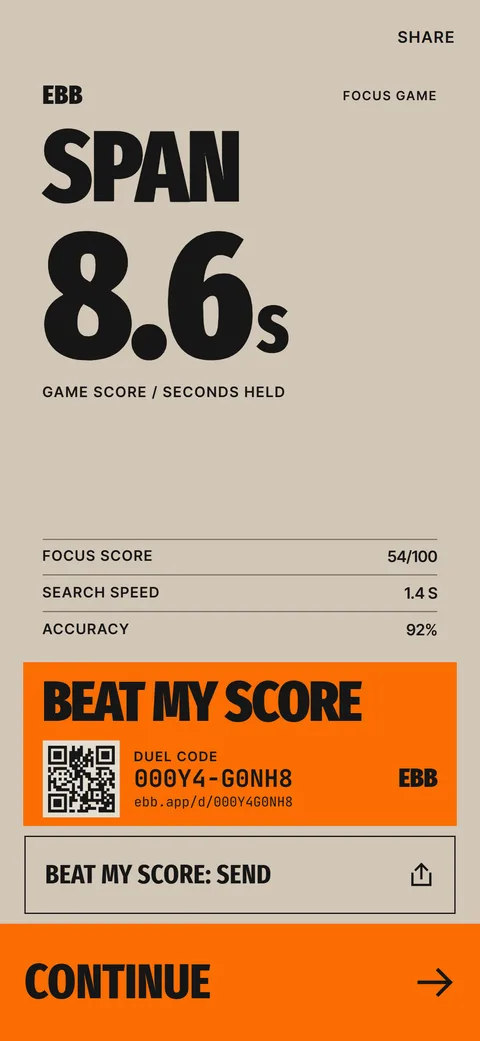
Ebb treats the habit, not the content. A 15-second focus round runs before the app opens, after which you pick how long to stay. Its focus game gives a span score, and the app says plainly that the score is a game result and not a health measure. See the focus game and the gate. Ebb is in development and not on the App Store yet.
Ebb does not judge content. It does not know what you watch. It runs when an app opens and counts the times you turn back, so a gate on a messaging app and on a video app look the same to it. That is intentional, and it keeps the data on your phone.
Frequently asked questions
What does brain rot mean in slang?
It names low-quality or repetitive online content, often short videos, and the foggy feeling after too much of it. Many people use it jokingly.
When was the term brain rot first used?
Oxford University Press traces the first recorded use to Thoreau's Walden in 1854.
Who named brain rot Word of the Year?
Oxford University Press chose it as the 2024 Word of the Year.
Is brain rot a medical condition?
No. It is an informal term. If your use of a phone affects sleep, mood or work, speak to a health professional.
How can I scroll less without deleting apps?
Add a pause before the app opens, choose a short time window and have a two-minute alternative ready.
Keep exploring
 The Ebb Focus GameSearch, Hold and Switch rounds, a span score in seconds and a daily game.The Ebb GateA Shortcuts automation opens Ebb first. Pass the round, then pick 5, 10 or 15 minutes.The Goldfish Attention Span MythWhere the 9-second goldfish claim came from, what goldfish can really do, and how attention actually works.