
The goldfish attention span myth: where 9 seconds came from
The idea that humans now have a shorter attention span than a goldfish, at 8 seconds against 9, is a myth. Goldfish remember things for months, and human attention depends on the task, not on one number. The claim spread from a 2015 marketing report and has been repeated ever since without solid support.
Coming soon to iPhone
Where does the 9-second claim come from?
The line was popularized by statistics that cite a 2015 report by the Canadian arm of a software company and say average human attention had fallen to 8 seconds, one second less than the 9 seconds assigned to a goldfish. Media outlets repeated it widely. When a public broadcaster's statistics programme traced the numbers in 2017, it found that the figure did not come from that company's research and that the website behind it listed only vague sources that nobody could confirm. The comparison traveled because it was catchy, not because it was measured.
Treat any statistic that cannot be traced to a method with caution, especially one that flatters a story you already believe.
What can goldfish actually do?
Much more than the myth suggests. According to the Wikipedia article on the goldfish, goldfish have a memory span of at least three months and can distinguish between different shapes, colors and sounds. They can be trained with positive reinforcement to respond to light signals and to perform tricks, and they learn to anticipate feeding times.
So the goldfish is a poor symbol for short attention. The animal in the myth has been maligned for years.
Is there a single human attention span?
No. The Wikipedia entry on attention span defines it as the amount of time spent concentrating on a task before becoming distracted, and says the measurement depends on what the attention is being used for. It separates transient attention, a brief response to a stimulus, from selective sustained attention, the focus that produces consistent results over time. Researchers disagree about the exact span of transient attention.
The same entry notes that people can choose repeatedly to re-focus on the same thing. That ability to renew attention is why you can watch a three-hour film. You do not hold one stretch of focus; you return to it many times.
What changes how long you can focus?
Quite a lot, and none of it is a fixed trait.
These factors move the number more than any generational shift. A teenager who plays a game for four hours has shown that they can sustain attention. The question is what the activity asks for.
- Interest. People can attend longer to something they find enjoyable or intrinsically motivating.
- Fluency. A task you perform smoothly holds attention longer than one you are still learning.
- State. Fatigue, hunger, noise and emotional stress reduce the time you stay on task.
- Design. Environments built to interrupt, such as notification-heavy phones, give attention more chances to break.
So is there a phone problem?
There may be, but the evidence for it is not the goldfish. A feed offers constant small rewards and frequent switching, and switching has costs. It is plausible that spending hours that way makes sustained tasks feel harder, though the science is unsettled and individuals differ. The honest position is that phones change how attention is used, and that nobody has a clean number for the effect.
You do not need a myth to act on that. If your attention feels fragmented, you can test small changes and see.
What does Ebb do with the myth?
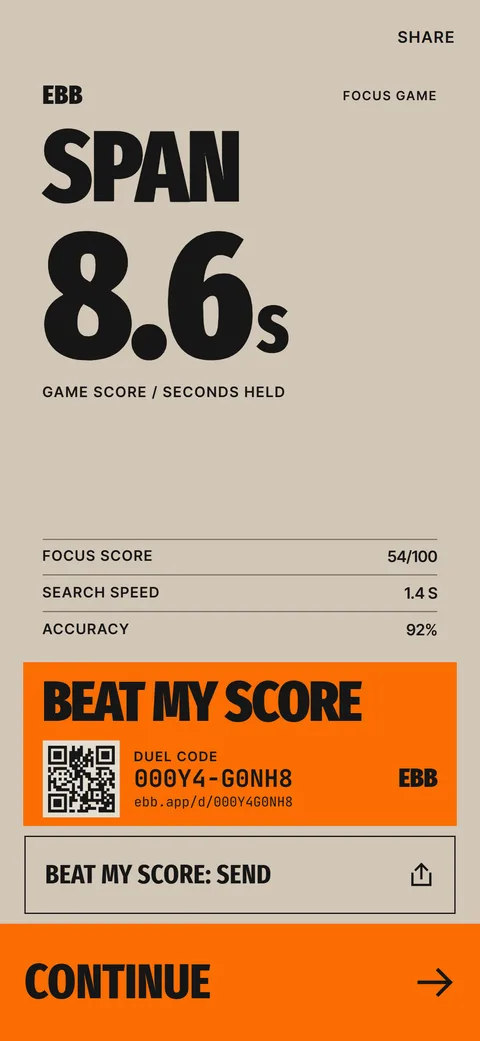
Ebb, an iPhone app in development, mentions the goldfish line on the result screen of its focus game and says outright that the myth is not true. It uses the 9 seconds only as a playful bar to compare your span score against, and tells you how many seconds you are over or under it. The score is a game result from the last seconds you played, and Ebb does not call it a medical or cognitive test. Read more on the focus game page.
How can you train focus without the myth?
Start with the conditions. Sleep, a quiet space and a clear task do more than any exercise. Then practice returning: when your mind wanders, notice it and bring it back, which is exactly the skill that sustained attention depends on. Use short blocks, as in the Pomodoro method on an iPhone, and take real breaks.
Keep expectations modest. A better week of focus is a good result, and you can compare weeks by what you finished instead of by a score.
Why do statistics like this spread?
They tell a story people already believe, which is that technology is eroding our minds. They are easy to quote, and the numbers sound precise. A headline with "8 seconds" beats a headline that says "it depends on the task". Once a figure appears in a few articles, others cite those articles, and the original source fades from view. Checking a number back to its method takes a few minutes and is a good habit.
What should you say when someone repeats it?
Keep it friendly. "I looked into that one, and it turns out the goldfish figure has no source" works better than a lecture. Then say something true: attention does depend on the task, and phones do pull at it. You can agree with the worry while correcting the number.
How can you test your own focus?
Pick a task you want to do, set a timer for 20 minutes and note how often you leave it. Count the slips. Try again tomorrow under better conditions, such as after a walk and with the phone in another room. Compare. The result tells you more about your habits than any national average and gives you something you can change.
What does this mean for how you work?
Plan around the real drivers of attention. Do hard tasks when you are fresh, not after a day of meetings. Reduce the number of things that can interrupt you. Choose tasks with a clear first step, because starting is the hardest moment. And accept that attention comes in waves; a ten-minute dip does not mean you have failed, only that it is time for a short break or a change of task.
Frequently asked questions
Do goldfish really have a 9-second attention span?
No. Goldfish can remember things for at least three months and can be trained to respond to signals.
Where did the goldfish attention span claim come from?
It spread from statistics that cite a 2015 corporate report and was repeated by media. A 2017 broadcaster's check could not trace the figure to any research.
What is the average human attention span?
There is no single number. Attention span depends on the task, interest, fatigue and environment.
Is attention span getting shorter?
The evidence is unsettled. Phones change how attention is used, but nobody has a clean measure of the effect.
Does the Ebb focus game measure attention span?
It produces a game score called span, in seconds, from a short Hold round. Ebb says it is not a medical or cognitive test.
Keep exploring
 The Ebb Focus GameSearch, Hold and Switch rounds, a span score in seconds and a daily game.Is Doomscrolling Bad for You? What the Evidence SaysWhat the research on doomscrolling can and cannot show, how to read the claims, and simple limits for news.Pomodoro Technique on iPhoneHow to run Pomodoro on iPhone with the Clock timer and a Focus, plus a sample day and what to do with breaks.